
The pandemic has brutally highlighted the inadequacy of India's administrative systems. And, the government has demonstrated its culpable inability to speed up vaccination in a timely manner, says Jaimini Bhagwati.
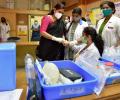
The first nationwide mock drill was held on January 2 which, the health ministry said, helped to iron out any glitches in the final execution and further refinement of the operational procedures.

If the government had paid enough to begin with, or if it had made serious advance purchase commitments that allowed the vaccine producers to mobilise necessary investment, then it is possible to imagine more free or subsidised vaccines such as are available in developed economies, asserts Mihir S Sharma.

The average rate of COVID-19 vaccination in the country has been 10.8 million per week. At that rate, it will take India till December 2024 to complete two billion doses.

The government is considering setting up air freight stations to enable direct movement of vaccines from pharmaceutical factories to the aircraft.

After healthcare and frontline workers, priority will be given to those above 50 years of age and the under-50 population groups with co-morbidities numbering around 27 crore, it added.
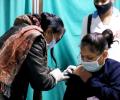
'Ideally, the efficacy data of all the trials should be there in the public domain, and as soon as possible.' 'It is difficult to understand the reason behind the authorisation.'
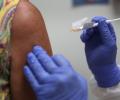
The ministry further stated that it was advisable to receive a complete schedule of the anti-coronavirus vaccine irrespective of past history of infection with COVID-19 as this will help in developing a strong immune response against the disease.

In view of the unprecedented and peculiar circumstances under which vaccination drive is devised as an executive policy, the "wisdom of the executive should be trusted", it said.

The Centre stressed that the next three weeks will be critical for the country reeling from the worst health crisis as it announced a series of measures to shore up medical infrastructure and supplies and scale up vaccination.

Prime Minister Narendra Modi will flag off the first phase of the pan India roll-out of COVID-19 vaccination drive at 10.30 am via video conferencing.

Based on this price, state governments, private hospitals, industrial establishments, etc would be able to procure vaccine doses from the manufacturers.

The NTAGI has also stated that those having laboratory test proven SARS-CoV-2 illness should defer COVID-19 vaccination for six months after recovery, the sources said.

Experts said attempts from China have increased in the last year, which further amplified after the Indian government banned Chinese applications post the Galwan clash.
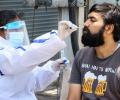
A steady decline in new COVID-19 cases has been recorded in India for the last 20 days, with 24 states witnessing a dip in active cases since the last week, the Union health ministry said.

Eminent virologist Shahid Jameel COVID-19 cases in the second wave also won't come down in as steady a fashion as they did after the first wave.

'The prioritisation of groups for COVID-19 vaccine shall be based on two key considerations -- occupational hazard and risk of exposure to infection, and the risk of developing severe disease and increased mortality'
The Bengal outcome can have a marginal impact on national politics. Whereas elections in UP next year might still change the course ahead of the parliamentary poll in 2024, observes Virendra Kapoor.

'Even after vaccines are given, precautions like using a mask and maintaining social distancing have to be taken.'
The Union government's role and the prices announced by the vaccine makers raises far too many disquieting questions, observes Prosenjit Datta.
With final preparations underway and the vaccine set to arrive in the national capital in the next couple of days, Rohit Datta, who was the first person to be diagnosed with coronavirus infection on March 1, said "it feels surreal".
'The vaccine policy should be such that all people should get the vaccine free.'
'We will see a kind of disaster which the country has not seen in the last 100 years.'

You need, first of all, to figure out how we messed it all up so badly. You need to fix accountability. None of that is happening, says Vir Sanghvi.

Maharashtra and Punjab, which are recording a surge in new COVID-19 cases, tightened curbs on Friday and the chief minister of the western state said lockdown is an option, as India added close to 40,000 cases in the biggest daily increase in nearly four months.
The second phase of Covid-19 vaccination in India will begin from March ,1 in which people above 60 years of age and those above 45 years of age with comorbidities will be vaccinated, Union Minister Prakash Javadekar said on Wednesday.

'We must not compromise with the standard, the quality. We don't need to be the first to launch a drug but what we need is a Made in India vaccine that the entire world can rely on'

The first COVID-19 vaccine shots in India were given on Saturday to nearly two lakh frontline healthcare and sanitary workers as Prime Minister Narendra Modi rolled out the world's largest inoculation drive against the pandemic that has caused 1,52,093 deaths and upended millions of lives in the country.
The Padma Bhushan was conferred on 17 personalities including N Chandrasekharan, chairman of Tata Sons, Krishna and Suchita Ella of Bharat Biotech, Cyrus Poonawalla, Satya Nadella, chairman of Microsoft, Sunder Pichai, chairman of Google.

'The future looks quite bleak unless we ramp up testing and start vaccinating on a war footing.'
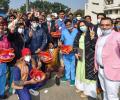
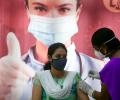
Loud applause and cheers rang out as the first jabs were administered to frontline workers at hospitals and healthcare centres across the country on Saturday at the start of the gargantuan COVID-19 vaccination exercise, hailed as a 'momentous' occasion in India's fight against the pandemic.

Interacting with state chief ministers, Modi underscored the enormity of what he described as the world's biggest vaccination exercise, which begins from January 16, saying over 30 crore citizens will get the jabs in the next few months in India against only 2.5 crore people vaccinated so far in over 50 countries in around a month.
'I'll give it to the vaccine manufacturers without guarantees, take the payment in advance and give me the supplies.' 'The moment you give me one lot of supply, I'll give you more.'

To build one's political and ideological arguments on the dead bodies piling up outside our crematoriums is despicable and breaches the basic tenet of human civility, argues Vivek Gumaste.

'You can still acquire the COVID-19 virus even if you are vaccinated.' 'But if you develop the disease, (after being vaccinated) the likelihood is that it will be mild.' 'It just makes sense to continue to take precautions, because you may be around a lot of unvaccinated people.'

'This is a tragedy that must be stopped.'
'We really need to look seriously to see if there are any local variants.'

'It is absolutely important for us to continue to message to people that they must wear masks, keep physical distancing, as much as is practically possible, at work or at home.'

India is in the midst of its biggest crisis since Independence. It is a national emergency and begs to be dealt with. Politics can wait. Lives need to be saved. We need to vaccinate India at a pace faster than any country in the world, asserts Ramesh Menon.

'We are going ahead with the trials assuming what we have is the vaccine.' 'There is also a chance that what you have is not the vaccine. Then, you have to go back to the drawing board again.' 'So far, there has been no success in developing a good vaccine against coronaviruses.' 'That's why there are hundreds of trials going on at different stages in different parts of the world.'
 © 2026 Rediff.com - Advertise with us - Disclaimer - Privacy Policy - Sitemap - Feedback - About us - Terms of use - Grievances